Research
Overview of my ongoing research topics
I study how environmental conditions constrain microbial life, and how microbial activity feeds back on ocean biogeochemistry.
A major goal is to quantify activity at depth where microbes live.
Measuring microbial activity at depth
When and where do in situ rate measurements change our view of ocean biogeochemical cycling?
Shipboard incubations can alter pressure and temperature, potentially biasing activity estimates. I therefore focus on quantifying microbial activity under conditions as close as possible to those at depth (in situ).
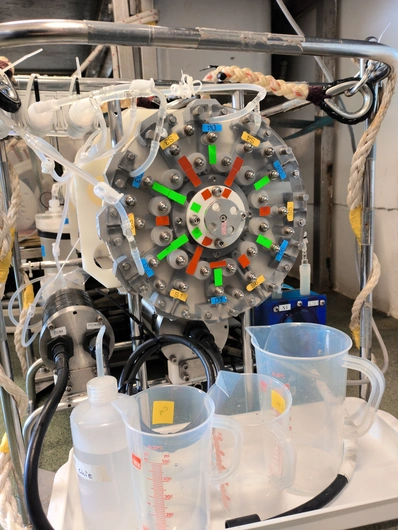
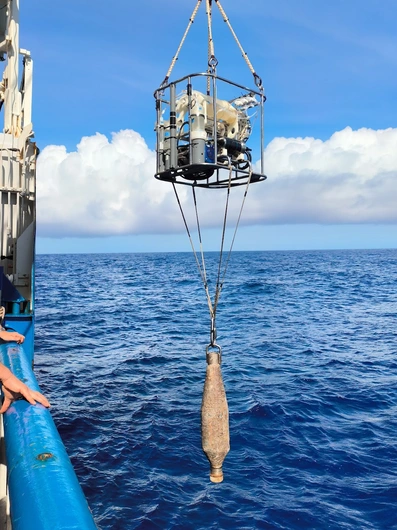
We use an in situ microbial incubator (ISMI) to perform incubations directly in the deep sea and measure activity under ambient conditions.
Life under pressure and cold
How do high hydrostatic pressure and low temperature affect microbial metabolism and activity?
High pressure and low temperatures characterize the deep ocean, yet microbes remain active. Understanding these constraints is essential for interpreting how microbial processing of organic matter responds to a changing ocean.
We compare activity and cell function across different pressure and temperature conditions, using in situ and controlled incubations.
Who is there, and what are they doing?
How do microbial communities and their activity patterns vary across depth, seasons, and water masses, and what drives those patterns?
Presence alone does not imply function: some cells may be dormant while others are active. Linking community structure to activity is key to understanding ecological roles and biogeochemical impact.
We quantify abundance, characterize communities, and measure activity rates.